
Currently, most mainstream permanent magnet brushless motors use surface-mount or embedded magnets assembled into a ring-shaped magnetic circuit. However, this method suffers from drawbacks such as high precision requirements for magnet manufacturing, difficult assembly, poor magnetic pole transition smoothness, and significant motor noise. Furthermore, this structure requires a soft magnetic material frame to fix the magnets, affecting assembly efficiency.
Radiating magnetic rings are a type of specially oriented circular permanent magnet, magnetized radially along the circumference of the ring. They can replace assembled magnetic rings and are widely used in servo motors, magnetic drives, magnetic bearings, and sensors.
[Image: Common magnetization methods for radiating magnetic rings]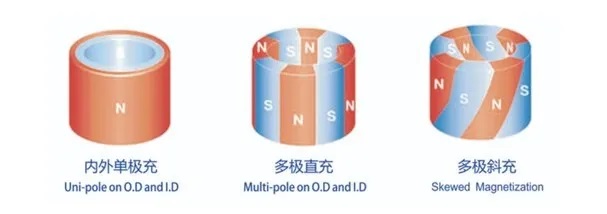
Les principaux avantages des anneaux magnétiques rayonnants sont les suivants :
1. Radiating rings are integral magnetic rings, allowing for better dimensional precision control and a simplified assembly process;
2. The surface field exhibits a sinusoidal waveform, is uniformly distributed, and has a small transition zone between magnetic poles, resulting in stable motor operation and low noise;
3. Diverse magnetization methods and magnetic field distributions are available, allowing for unipolar radiation, multi-pole direct charging, and multi-pole oblique charging magnetization, enabling more flexible magnetic circuit design.
Radiation magnetic rings can be categorized by orientation into magnetic field-oriented and pressure-oriented rings. Sintered or bonded rings are mostly magnetic field-oriented, while hot-pressed/hot-deformed rings are mostly pressure-oriented. Based on material, they can be classified as ferrite permanent magnet rings, rare-earth permanent magnet rings, and other types. Rare-earth permanent magnet rings mainly include samarium cobalt permanent magnet rings and neodymium iron boron permanent magnet rings, with sintered or hot-pressed/hot-deformed neodymium iron boron rings exhibiting the highest magnetic performance. According to shape, rings with an inner-outer diameter ratio less than 0.7 are considered thick-walled, while those with a ratio greater than 0.9 are considered thin-walled.
Due to the mature and inexpensive bonding process, bonded neodymium iron boron radiation rings account for the largest share of production. However, bonded magnetic rings have lower density and performance, limiting their application in high-end scenarios. High-performance sintered and hot-pressed/hot-deformed NdFeB radiation magnetic rings are prone to breakage during preparation, magnetization, and assembly due to significant differences in the shrinkage ratio and thermal expansion coefficient between the easy and difficult magnetization axes of NdFeB grains. This results in low yield and generally high prices. Japan was an early adopter of radiation ring equipment and processes, and its equipment precision, stability, and product grades all offer significant advantages. Domestic research on radiation rings started later, but many companies and research institutions are now able to stably supply radiation rings of various sizes and grades.
Regarding the dimensions of radiation rings, generally speaking: bonded radiation rings have fewer size limitations; hot-pressed radiation rings are mostly thin-walled magnetic rings, with diameters typically below 30mm and wall thicknesses below 3mm; sintered radiation rings can be manufactured with outer diameters greater than 200mm, wall thicknesses exceeding 5mm, and heights less than 50mm, but due to yield rate and cost limitations, the market mainly offers small-diameter magnetic rings with outer diameters below 100mm.