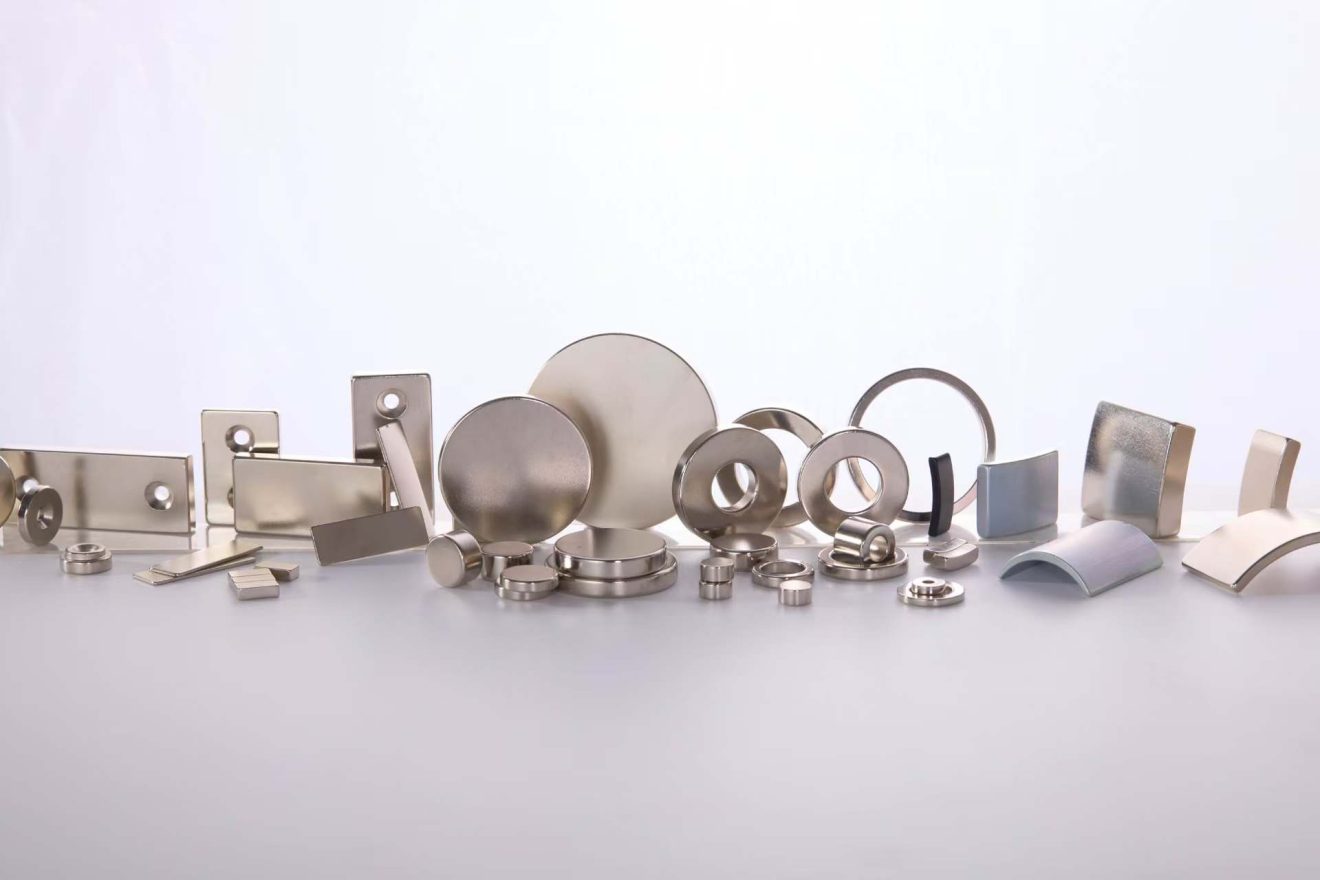
We all know that the main raw materials for sintered NdFeB permanent magnets are neodymium, iron, and boron. However, many other elements are added to the raw materials, each playing a different role in the magnet. Manufacturers often design product formulations based on user needs, making the raw material formulation a closely guarded secret.
The dozen or so elements in sintered NdFeB magnets are like the various seasonings we add to a dish. It is the scientific and systematic combination of these elements with different intrinsic properties and functions that creates the various grades and properties of NdFeB magnets. Understanding the significance of each element is crucial for better comprehending the performance and manufacturing costs of different grades. Below, we briefly introduce the value of these elements.
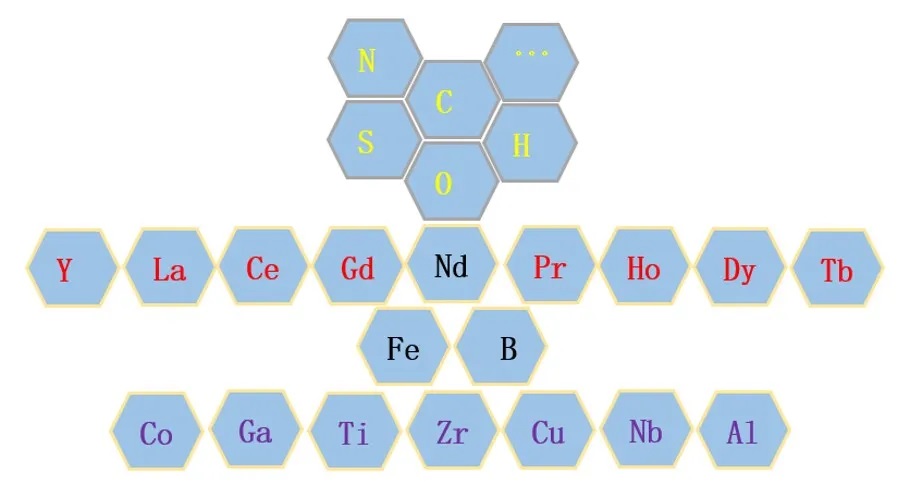
For easier understanding, we can divide the constituent elements of NdFeB magnets into three categories:
◇ First, the main elements RE (Ce, Gd, Nd, Dy, etc.), Fe, and B, which are primarily responsible for forming the RE2Fe14B main phase grains.
◇ Second, minor elements such as Al, Co, Ga, and Zr are mainly responsible for optimizing the coating of grain boundaries onto the main phase grains.
◇ Third, impurity elements, such as carbon and oxygen, are unavoidably introduced into raw materials and production.
A schematic diagram of NdFeB element types is shown below.
In the production process, to ensure different formulations achieve optimal performance, we typically need to inspect and process raw materials before use to meet certain basic requirements. However, due to different production processes employed by raw material manufacturers, deviations often occur. For example, the ratio of Pr to Nd may vary from 20:80 to 25:75, GdFe may be less than 75%, and the B content in BFe may fluctuate significantly between different batches. Therefore, we must consider the actual content reported in the quality inspection report for each batch before using the raw materials.
Each element in a NdFeB magnet has its own unique properties, such as:
◇ The introduction of La and Ce elements reduces the remanence (Br) and coercivity (Hcj) of the magnet, but they are very inexpensive, reducing costs;
◇ Pure Nd replacing PrNd to form REFeB has very high saturation magnetization and can be used to prepare magnets with ultra-high remanence;
◇ The introduction of Tb elements can significantly increase the Hcj of the magnet, but it is extremely expensive;
◇ Gd elements are relatively inexpensive, and the REFeB formed from them has the highest Curie temperature, allowing for the preparation of high-temperature resistant magnets, but it significantly reduces Br.
To understand how to combine elements to manufacture magnets with the required performance at the lowest cost, we need to understand the properties of each element in NdFeB.
The material cost accounts for 80%-90% or more of the total cost, primarily represented by the “high” and “low” categories. The “-” indicates very small amounts added or low prices, having little impact on overall cost. The addition of La and Ce is mainly for cost reduction; in recent years, with continuous technological advancements, Ce magnets have been increasingly used in higher-grade magnets.
By gaining a deep understanding of the characteristics of these elements and clarifying the impact of their addition on sintering processes, sintering density, aging processes, and product performance, we can guide the production of NdFeB products with high cost-effectiveness.