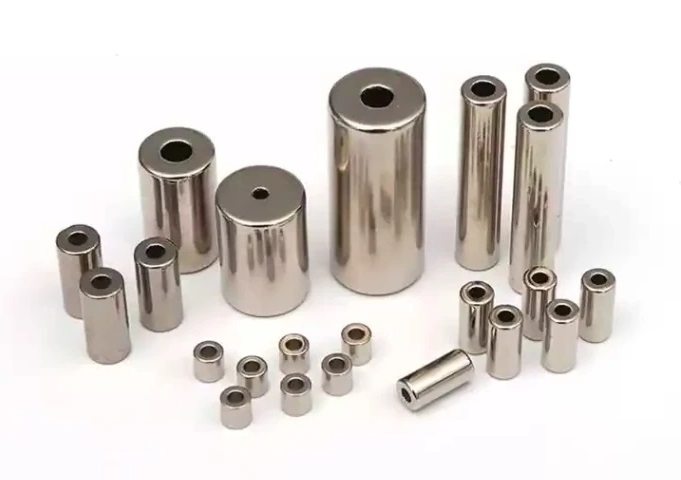
You may have heard of coreless motors, but what exactly are they, and how do they differ from regular motors? What kind of permanent magnets are used in coreless motors? Today, let’s explore these questions together.
With the continuous development of science and technology, electric motor technology is also constantly innovating. Especially now, the industrial sector is placing higher expectations and requirements on the servo characteristics of electric motors, leading to the development of coreless motors. Coreless motors belong to the category of DC permanent magnet servo control motors and can also be classified as micro-motors.
Coreless motors possess outstanding energy-saving characteristics, sensitive and convenient control characteristics, and stable operating characteristics, demonstrating significant technological advancement. As a high-efficiency energy conversion device, they represent the development direction of electric motors in many fields.
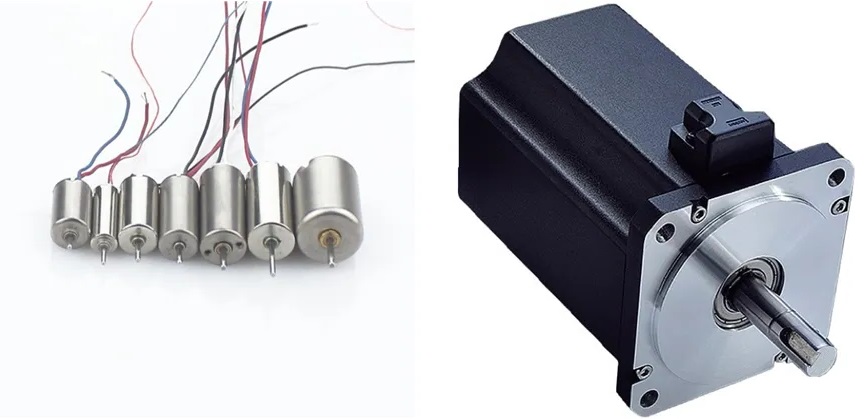
Structure and Principle of Coreless Motors
The diagram below shows a simplified structure of a typical coreless motor. Coreless motors are DC permanent magnet motors, differing from ordinary brushed and brushless DC motors primarily in their use of a coreless rotor, also called a hollow cup rotor.
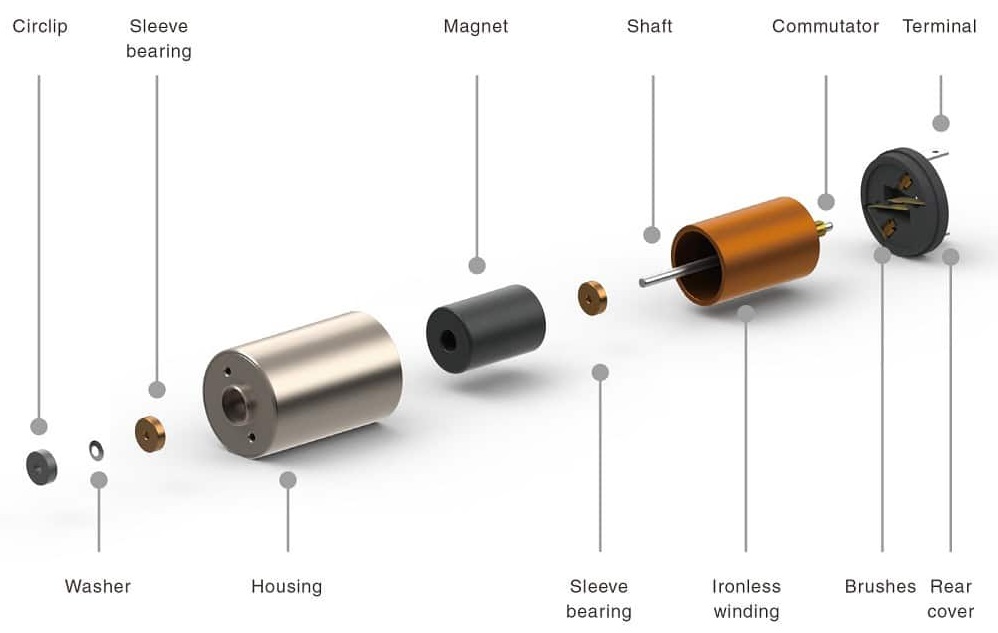
This rotor is directly wound with wire, without any other structural support. The winding itself is cup-shaped, forming the rotor’s structure (as shown in the diagram). This structural change significantly improves the motor’s operating characteristics, resulting in outstanding energy savings and, more importantly, control and drive characteristics unattainable by iron-core motors.
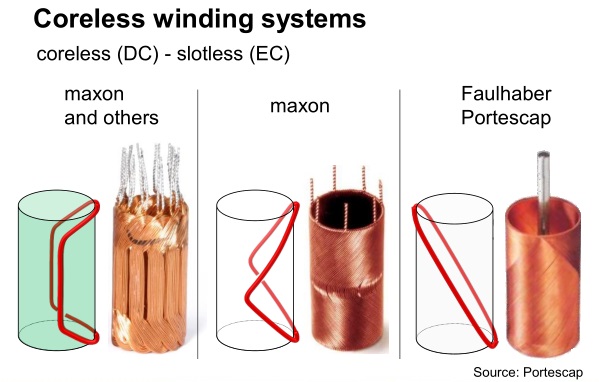
Coreless motors are available in brushed and brushless versions. Brushed coreless motors have a coreless rotor, while brushless coreless motors have a coreless stator. Common coreless motor models on the market have diameters of Φ4, Φ6, Φ7, Φ8, Φ10, Φ12, and Φ15.
Advantages and Applications of Coreless Motors
Coreless motors offer a range of advantages, including high power density, high efficiency, no torque lag, no cogging effect, low starting torque, no radial force between the rotor and stator, smooth speed curve, low noise, and good heat dissipation.
The application of coreless motors has expanded rapidly over the past decade, from military and high-tech fields to large-scale industrial and civilian sectors, especially in industrialized countries, where they are now involved in most industries and many products.
1. Fast-response servo systems. Examples include rapid flight direction adjustment for missiles, servo control of high-magnification optical drives, rapid autofocus, highly sensitive recording and detection equipment, industrial robots, and bionic prosthetics. Coreless motors effectively meet these technical requirements.
2. Products requiring smooth and sustained drive components. Examples include various portable instruments, personal protective equipment, field work equipment, and electric vehicles. With the same power supply, the power supply time can be more than doubled.
3. Various aircraft, including aviation, aerospace, and model aircraft. 4. Hollow cup motors, with their lightweight, small size, and low energy consumption, can significantly reduce the weight of aircraft.
5. Various consumer electronics and industrial products. Using hollow cup motors as actuators can enhance product quality and performance.
6. Due to their small size, hollow cup motors are widely used as power components in many compact products. Examples include toys and gifts (toy cars, model airplanes, etc.), beauty and massage products (facial brushes, facial massagers, etc.), and daily necessities (electric toothbrushes, shampoo brushes, hair straighteners, etc.).
Hollow Cup Motor Magnets: Hollow cup motors generally use sintered neodymium iron boron permanent magnets, which possess high remanence, high coercivity, and high energy product, making them the most suitable permanent magnet material for hollow cup motors currently available. For motors of the same size and winding specifications, the strength of the magnet directly affects the motor’s rotational speed. The common neodymium iron boron magnets used in coreless motors are ring-shaped, with properties such as N40 and N45, and a temperature resistance of around 80℃-100℃.