
Do magnets with the same performance and volume have the same magnetic force? It is said on the Internet that the magnetic force of NdFeB magnets is 640 times their own weight. Is this credible?
This question can actually be expanded, that is, what factors are related to the suction force of magnets. First of all, it should be made clear that magnets only have suction force on ferromagnetic materials. There are only three types of ferromagnetic materials at room temperature, namely iron, cobalt, nickel and their alloys. There is no suction force on non-ferromagnetic materials.
Some formulas for calculating suction force can be found on the Internet:
F=k*B²*S/2
F=0.577*S*B²
Are these formulas accurate? The answer is inaccurate, but the trend is correct. The magnitude of the suction force of a magnet is related to the magnetic field strength and the adsorption area. The greater the magnetic field strength, the larger the adsorption area, and the greater the suction force.
Then the next question is, are the magnets of the same volume, flat, cylindrical, and slender, the suction force the same? If not, which one has the greatest suction force?

First of all, it is certain that the suction force is not the same. Which suction force is the largest? We need to connect it with the definition of the maximum magnetic energy product. When the working point of the magnet is near the maximum magnetic energy product, the magnet has the largest work energy. The adsorption force of the magnet is also a manifestation of work, so the corresponding suction force is also the largest. It should be noted here that the object to be attracted needs to be large enough to completely cover the size of the magnetic pole, so that the material, size, shape and other factors of the object to be attracted can be ignored.
How to judge whether the working point of the magnet is at the maximum magnetic energy product point? When the magnet is in a state of direct adsorption with the material to be attracted, its adsorption force is determined by the size of the air gap magnetic field and the adsorption area. Taking a cylindrical magnet as an example, when H/D≈0.6, its center Pc≈1, and when it is near the working point of the maximum magnetic energy product, the suction force is the largest. This is also in line with the rule that magnets are usually designed as relatively flat shapes as adsorbents. Taking the N35 D10*6 magnet as an example, the FEA simulation can calculate that the suction force of the adsorbed iron plate is about 27N, which almost reaches the maximum value of magnets of the same volume, which is 780 times its own weight.
Square magnets are similar to circular magnets. When directly adsorbed to the material being adsorbed, the center Pc≈1, that is, it is near the maximum magnetic energy product working point, and the suction force will reach the maximum value of magnets of the same volume, such as 10*10*6.5 or 15*10*8.
Of course, the above is only the adsorption state of a single pole of the magnet. If it is multi-pole magnetization, the suction force will be completely different. The suction force of multi-pole magnetization will be much greater than that of single-pole magnetization (under the premise of a small distance from the adsorbed object).
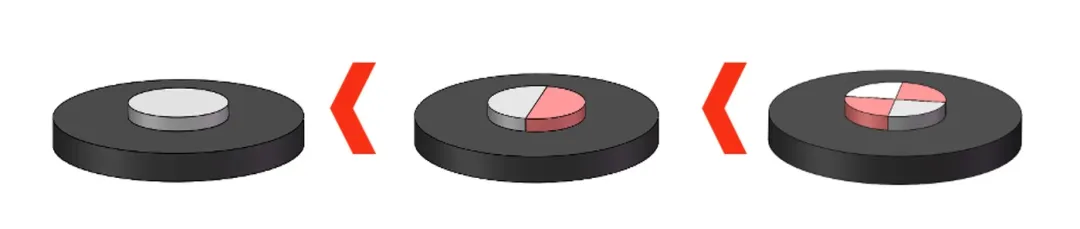
Why does the suction force of a magnet of the same volume change so much after being magnetized with multiple poles? The reason is that the adsorption area S remains unchanged, while the magnetic flux density B value through the adsorbed object increases a lot. From the magnetic force line diagram below, it can be seen that the density of magnetic force lines passing through the iron sheet of a multi-pole magnetized magnet is significantly increased. Taking the N35 D10*6 magnet as an example, it is made into a bipolar magnetization. The suction force of the FEA simulation adsorbing the iron plate is about 1100 times its own weight.

After the magnet is made into a multi-pole magnet, each pole is equivalent to a thinner magnet, and its Pc value has changed. It can no longer be calculated according to the Pc value of the overall size. Therefore, its optimal size is no longer H/D≈0.6, but a flatter magnet. The specific size is related to the multi-pole magnetization method and the number of poles.