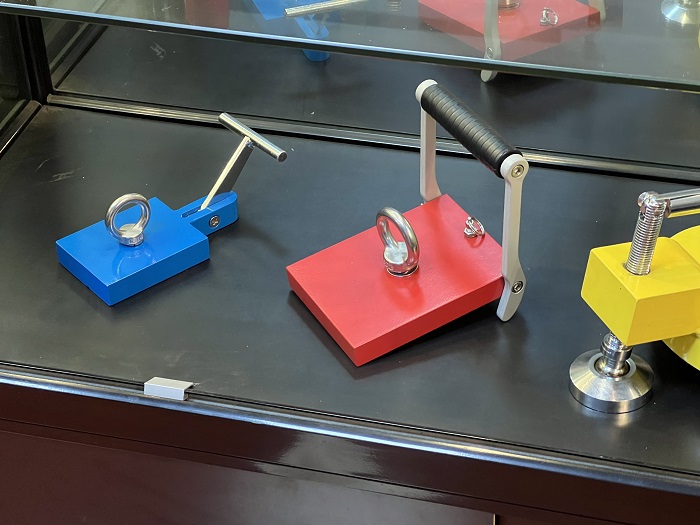
The applications of neodymium iron boron permanent magnets can be broadly categorized into adsorption, repulsion, induction, and electromagnetic conversion. The required magnetic field varies depending on the specific application.
🔹 The limited space in 3C products, coupled with the need for high adsorption strength, prevents significant increases in magnet size. Therefore, magnetic circuit design is crucial to enhance magnetic field strength.
🔹 In applications requiring magnetic field sensing, excessively diffuse magnetic lines of force can cause false triggering of Hall effect sensors. Magnetic circuit design is needed to control the magnetic field range.
🔹 In situations where one side of the magnet requires high adsorption strength while the other side needs magnetic field shielding, excessively high magnetic field strength on the shielding side can interfere with the operation of electronic components. Magnetic circuit design is also necessary to address this issue.
🔹 Applications requiring precise positioning, uniform magnetic fields, etc., also present challenges.
In all these cases, using a single magnet is insufficient. Furthermore, the high price of rare earth elements significantly impacts product cost due to the size and quantity of magnets required. Therefore, while meeting adsorption requirements or ensuring normal operation, the magnetic circuit structure can be modified to suit different application scenarios, while simultaneously reducing the amount of magnets used to lower costs.
Common magnetic circuits can be broadly categorized into HALBACH ARRAY arrays, multipole magnetic circuits, focused magnetic circuits, circuits with added magnetic materials, flexible transmission, single-sided magnets, and magnetic focusing structures. Each of these will be introduced in detail below:
HALBACH ARRAY
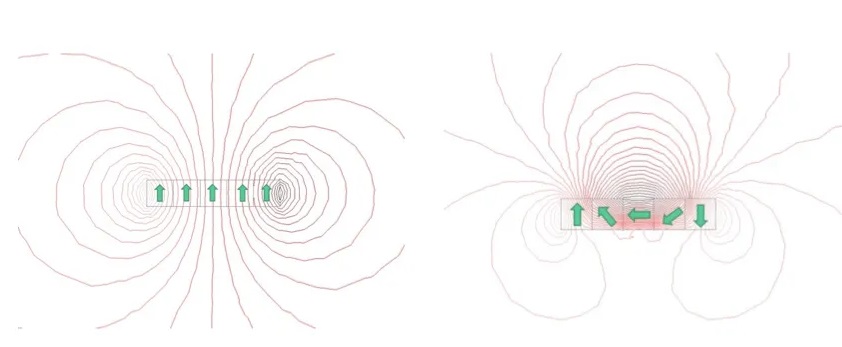
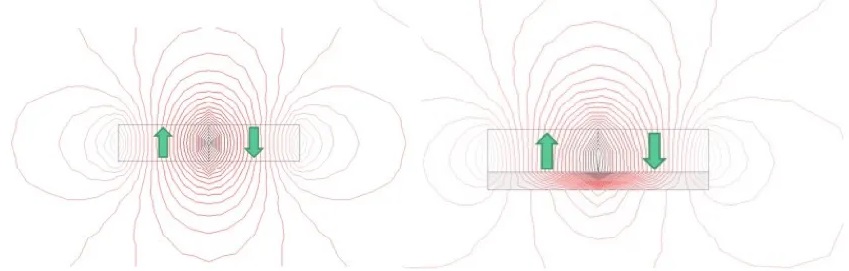
This is an engineering-ideal structure, aiming to generate the strongest magnetic field with the minimum amount of magnets. Due to the special magnetic circuit structure of the HALBACH ARRAY, most of the magnetic field loop can circulate inside the magnetic devices, thereby reducing leakage flux and achieving magnetic concentration. This enables a self-shielding effect in non-working areas. With an optimized toroidal HALBACH ARRAY magnetic circuit design, at least 100% shielding can be achieved in non-working areas. As shown in the figure, the magnetic field lines in a conventional magnetic circuit are symmetrically divergent, while most of the magnetic field lines in the HALBACH ARRAY are concentrated in the working area, thus increasing magnetic attraction.
Left: Conventional magnetic circuit Right: HALBACH ARRAY
Multipole Magnetic Circuits
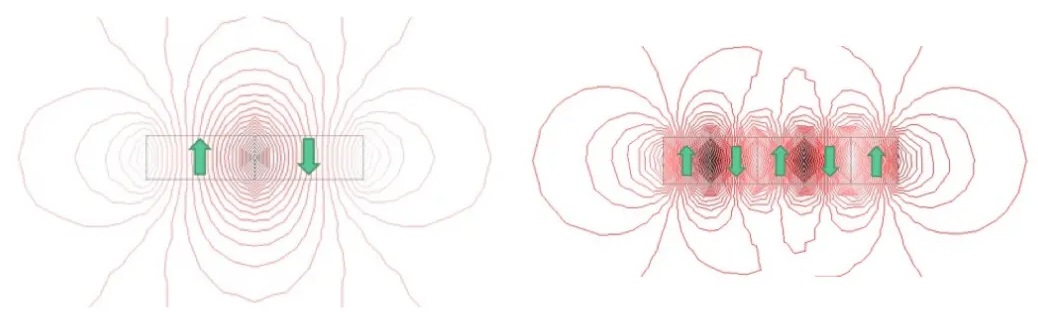
Multipole magnetic circuits primarily utilize the characteristic that magnetic field lines preferentially select the nearest opposite pole to form a magnetic loop. Compared to ordinary monopole magnets, the magnetic field lines (magnetic field) in multipole magnetic circuits are more concentrated on the surface, especially with a higher number of poles. There are two types of multipole magnetic circuits: one uses a single magnet with multiple poles, and the other uses multiple monopole magnets adsorbed together. The difference between these two methods lies in cost; their actual function is the same. Multipole magnetic circuits offer a significant advantage in attracting objects with small gaps.
Focused Magnetic Circuit
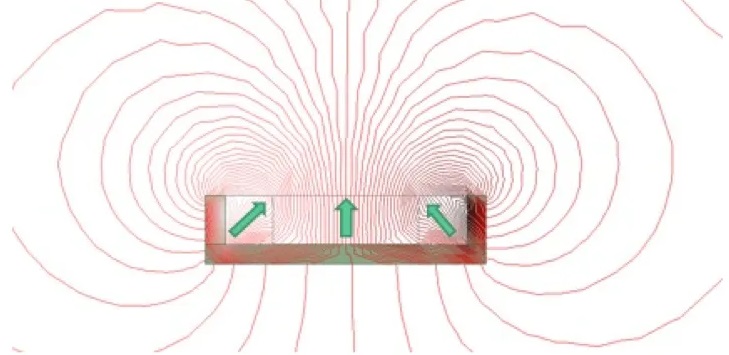
A focused magnetic circuit utilizes a special magnetic path to concentrate the magnetic field into a small area, making the magnetic field in that area very strong, even reaching 1T. This is very helpful for accurate positioning and local induction.
Magnetic materials
Magnetic materials utilize the principle that magnetic field circuits preferentially choose the path of least magnetic resistance. By using high-permeability materials (SUS430, SPCC, DT4, etc.) in the magnetic circuit, the direction of the magnetic field can be well guided, thereby achieving the effects of local magnetic concentration and magnetic isolation.
Left: Conventional magnetic circuit Right: Magnetic circuit after adding magnetic material
Magnetic circuit after adding magnetic material 2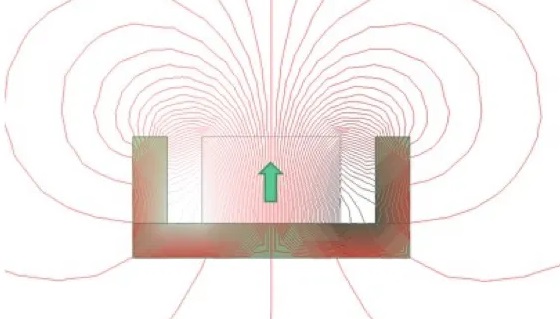
Flexible Transmission
Flexible transmission is characterized by non-contact, flexible transmission achieved through the attraction and repulsion forces generated by magnets. It is small in size, simple in structure, and its torque can be varied according to the magnet volume and air gap size, offering a large adjustable range.
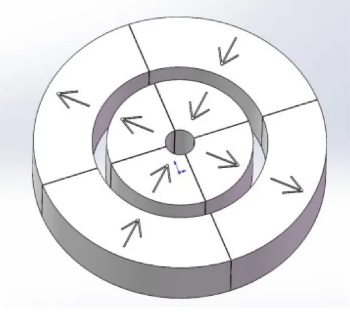
Single-Sided Magnetism
Single-sided magnetism is characterized by shielding one side of the magnet’s polarity while retaining the other. Direct attraction is strong, but the magnetic force weakens significantly with increasing distance.
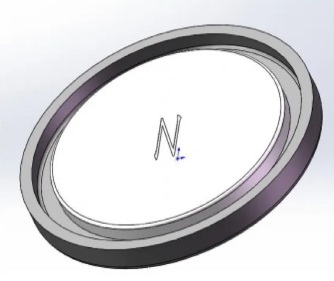
Magnetic Concentration Structure
This structure features magnets and an iron yoke arranged with opposite polarities. As the ratio of magnet thickness to yoke thickness increases, the thicker the yoke, the smaller the divergence of magnetic lines of force. Magnetic concentration structures can be flexibly designed according to the air gap size to achieve optimal results, effectively saving magnets and producing a uniform magnetic field distribution along the yoke. However, the disadvantage is higher assembly costs.
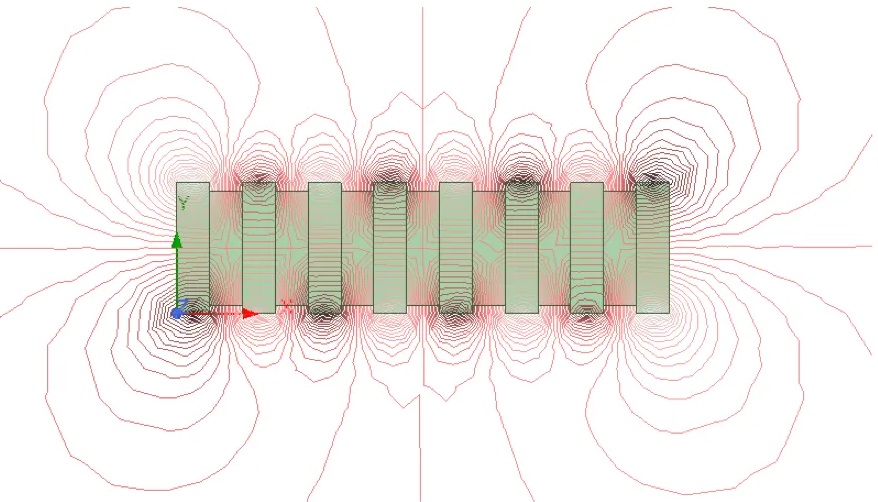
Dailymag Underwater Anchor Magnets is Focused Magnetic Circuit