
Surface Magnetism
Concept: Surface magnetism refers to the magnetic flux density at a specific point on the surface of a magnet (the surface magnetism at the center and edges will differ). It is a value measured by a gaussmeter in contact with a specific surface of the magnet, and does not represent the overall magnetic properties of the magnet.
Measurement: A gaussmeter, also called a Tesla meter, is generally used to measure the surface magnetism of a magnet. Different manufacturers use different Hall effect sensors in their gaussmeters, resulting in different surface magnetism readings for the same magnet. Furthermore, it’s important to note that different countries use different gaussmeter measurement standards.
Surface magnetism is related to the magnet’s height-to-diameter ratio (the ratio of the magnet’s height to its diameter). A larger height-to-diameter ratio indicates a higher surface magnetism, meaning a larger surface area perpendicular to the magnetization direction results in a lower surface magnetism; conversely, a larger dimension in the magnetization direction results in a higher surface magnetism.
Magnetic Flux
Concept: In a uniform magnetic field with magnetic induction intensity B, there exists a plane with area S perpendicular to the magnetic field direction. The product of the magnetic induction intensity B and the area S is called the magnetic flux through this plane, abbreviated as magnetic flux, denoted by “Φ”, and its unit is Weber (Wb). Magnetic flux is a physical quantity representing the distribution of a magnetic field. It is a scalar quantity, but it can be positive or negative, with the sign only indicating its direction. Φ = B·S. When there is an angle θ between the perpendicular planes S and B, Φ = B·S·cosθ.
(Diagram of magnetic flux)
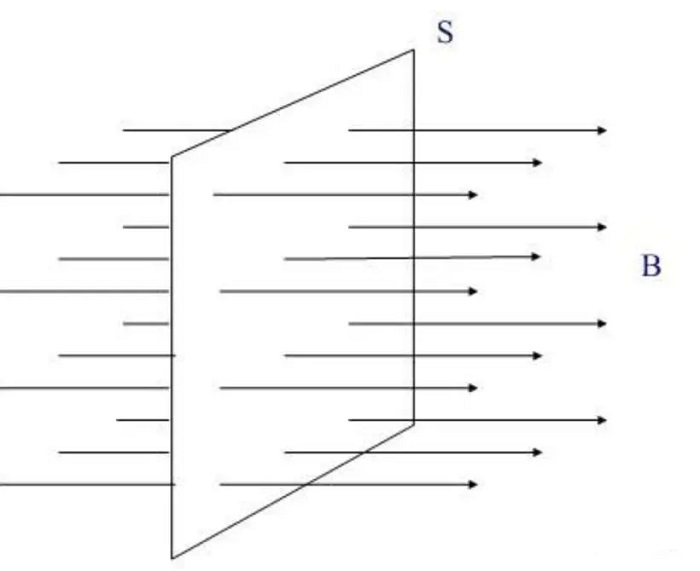
The magnitude of the magnetic flux through a plane can be visualized by the number of magnetic field lines passing through that plane. In the same magnetic field, the greater the magnetic induction intensity, the denser the magnetic field lines. Therefore, the larger B and the larger S are, the greater the magnetic flux, meaning the more magnetic field lines pass through the plane. If there are two magnetic fluxes with opposite directions through a plane, the resultant magnetic flux is the algebraic sum of the magnetic fluxes in opposite directions.
Measurement: A magnetometer is an instrument for measuring magnetic flux. It requires a measuring coil (copper wire with a diameter of 0.1-0.5 mm). In recent years, domestic permanent magnet manufacturers have widely adopted Helmholtz coils for batch product testing. (A Helmholtz coil is a device that generates a uniform magnetic field over a small area. Due to its open nature, it is easy to place or remove other instruments, and it can also be directly observed visually, making it a commonly used device in physics experiments. It is named after the German physicist Hermann von Helmholtz.)
Remanence
Concept: Remanence refers to the magnetic flux density retained in a ferromagnetic material after it has been magnetized to saturation using an external magnetic field and then the magnetic field is gradually reduced to zero. It is called remanent magnetic flux density (Br). Remanence is determined by the inherent properties of the magnet itself; the remanence of the same magnet remains constant under specific conditions, exhibiting a single value.
Relationship between Remanence and Surface Magnetism: Both are measured in Gauss, but there is no direct correlation between surface magnetism and remanence. Two magnets with the same remanence may have different surface magnetisms. Surface magnetism is affected by the shape, size, and magnetization method of the magnet.
1) For two magnets with the same shape, properties, and size, the one with the higher surface magnetism has stronger remanence.
2) For two magnets with different shapes, properties, or sizes, the magnitude of their remanence cannot be simply determined by the difference in surface magnetism.
Relationship between Remanence and Magnetic Flux: When the magnetic circuit of a magnet is closed, a fluxmeter can be used to measure the magnetic flux, and then the remanence can be calculated. Br = φ/n/s, where: φ represents magnetic flux, n represents the number of turns of the coil, and s represents the cross-sectional area of the magnet.