
Both Samarium Cobalt and neodymium iron boron are metallic materials. Due to the excellent conductivity of metallic materials, their resistivity is very low. This is not ideal for rotating machinery like electric motors, as it introduces eddy current losses, causing heating of the rotating machinery, including the magnets. Therefore, eddy current losses in rotating machinery must be considered by magnet and motor designers. Today, we’ll explore what eddy current losses in magnets are and how to avoid them.
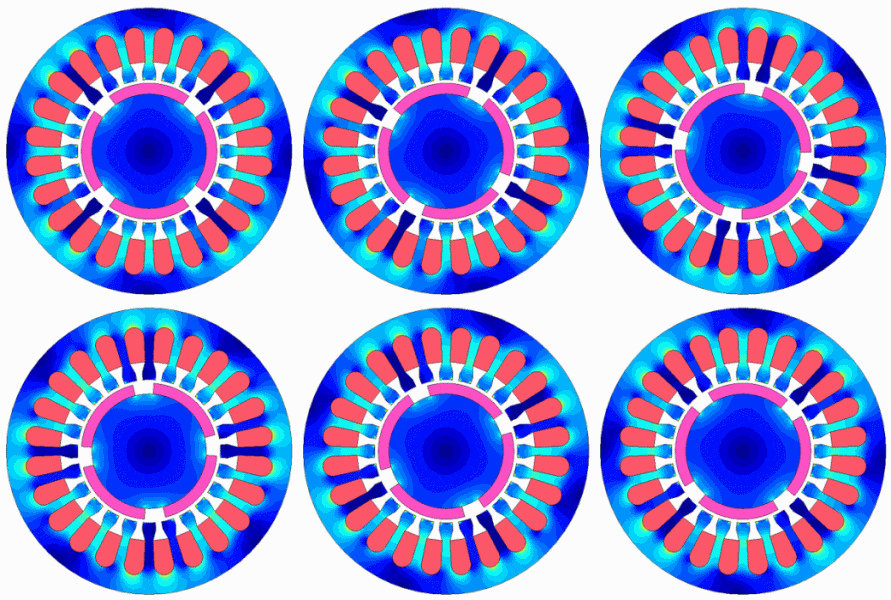
To understand and reduce eddy current losses, we must first understand how they occur. This requires introducing the concept of the skin effect.
Skin Effect (or Skin Concentration Effect): When alternating current passes through a conductor, the current density distribution across the conductor’s cross-section is uneven. As the frequency of the current change increases, the current becomes increasingly concentrated on the conductive surface, while the current inside the conductor decreases. This phenomenon is called the skin effect. The higher the frequency, the stronger the skin effect.
The cause of the skin effect is eddy currents. According to the law of electromagnetic induction, an alternating electric field generates an alternating magnetic field. When alternating current passes through a conductor, an alternating magnetic field is generated inside and around the conductor, inducing eddy currents in a vortex-like pattern inside the conductor.
The closer to the center of the conductor, the higher the induced electromotive force (EMF) generated by the alternating magnetic field within the conductor. The stronger the eddy current, the stronger its opposition to the original current, resulting in a lower current density near the conductor’s center and a higher current density near the surface.
Since the induced EMF increases with frequency, the skin effect also becomes more pronounced with increasing frequency. When a high-frequency current passes through a conductor, it can be assumed that the current flows only through a very thin layer on the conductor’s surface. This is equivalent to a reduced cross-section of the conductor, significantly decreasing the effective utilization rate of the conductor material.
Eddy Current Loss: Because samarium cobalt and neodymium iron boron permanent magnets have very low resistivity, eddy currents in alternating electric fields are generally quite large. Due to the thermal effect of the current, eddy currents cause the magnet to heat up, and excessively high temperatures can lead to thermal demagnetization.
The magnitude of eddy current loss is related to factors such as the change in the magnetic field, the conductor’s motion, the conductor’s geometry, and its permeability and conductivity. In rotating machinery, higher rotational speed (equivalent to frequency) and higher permeability, along with lower resistivity, result in a smaller skin depth and greater losses. In electric vehicles, elevators, and other fields, permanent magnet motors are typically controlled by inverter power sources for speed control. The presence of high-order harmonics at the carrier frequency also increases eddy current losses in the magnet and causes thermal demagnetization.
Reducing Eddy Current Losses in Sintered NdFeB Magnets by Increasing Resistivity
From a motor design perspective, several technical methods have been proposed to reduce eddy current losses in rotating machinery using permanent magnets, such as shielding pillars around the magnet, segmented magnets, and side-isolated magnets.
From the perspective of the magnet itself, one of the most effective methods to reduce eddy current losses in motors is to use bonded magnets. The presence of the binder and its sufficiently high volume fraction makes the resistivity of bonded magnets 10² to 10⁴ times that of sintered magnets. However, this significantly limits the power and maximum operating temperature of the motor. Therefore, the most direct method is to increase the resistivity of the sintered magnet itself.
There are various methods to increase the resistivity of sintered magnets, such as adding high-resistivity powders (Al₂O₃, etc.) or coating with SiO₂. However, these methods will affect the magnetic properties of the sintered magnet to some extent. Therefore, a balance needs to be struck between resistivity and magnetic properties during magnet development.